
How to know if you need a fret level
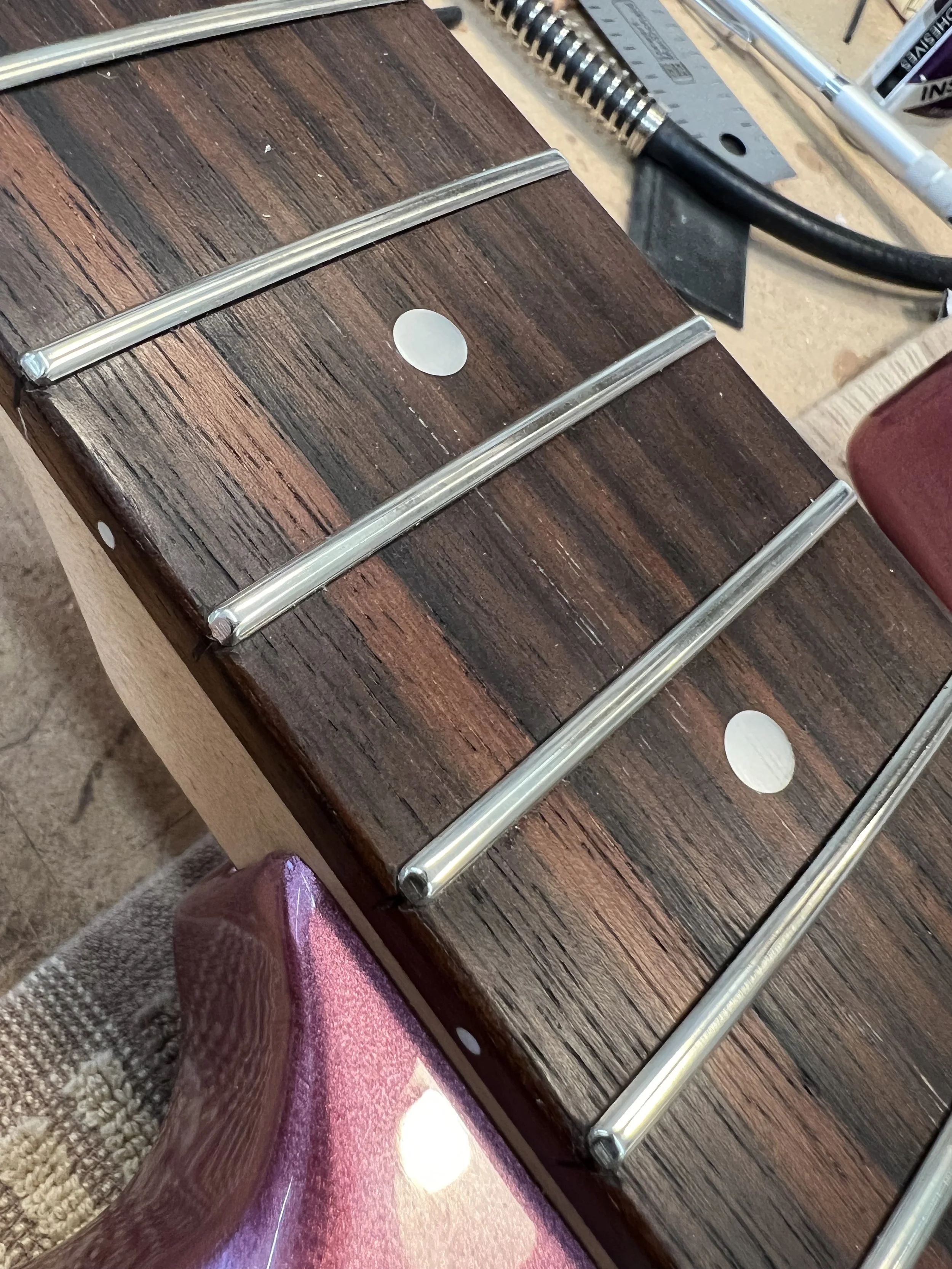
This is what frets look like when they’re properly leveled, crowned, and polished. Shiny like jewels.
So your guitar strings are buzzing in places when you play it, or you depress a string and the notes don’t ring out. Chances are, you need a fret level - potentially even a refret. But here’s what’s really unfortunate about it: theoretically, this should hardly ever happen. That’s right; one of the most common instrument repairs should be rare, even unnecessary.
The need for a fret level is usually the result of one of three things: 1. Your instrument is poorly made, 2. You haven’t taken great care of it, or 3. You play like Johnny Ramone. If the cause is #3, settle down sir! If the cause is #2, you know who you are. Get a humidifier. But more often than not, we’re sorry to say, the cause is #1.
Low quality instruments often mask poor fretwork by setting the action high.
A couple of years ago, a brand new Squier came into the MachMachines shop for a setup, but when the neck relief and string action were set, the strings were fretting out from the middle of the fretboard up. Turns out some of the frets weren’t installed properly, and the frets were unlevel across the board.
How could this happen on an instrument that just came out of the store?
If you’re buying a budget instrument, you are going to get budget materials, budget workers, and limited time or skill for the finer details - like quality fret installation - that make an instrument play well. Very often factory shops are trying to ship an instrument that’s just good enough that someone can pick it up and strum it in the store without buzzing, which can be achieved by setting the action higher than most people find comfortable. We often find that when our players bring in an instrument for a setup and complain about the action being too high, the problem is how it was fretted in the factory.
What does it mean for the frets to be level?
When a player plucks a string, it vibrates and rotates in a circular motion. To play the correct note when depressed, the string has to be able to rotate from that fret to the bridge saddle. In order for every note on the fretboard to play correctly, the frets have to be at the same height in relation to each other. (Note that neck relief plays a role in this, as well, but that’s a topic for a future Bench Notes post.)
Here’s what the process entails:
Adjust the truss rod to make the neck as straight as possible
Using a machinist’s straightedge, evaluate the height of every fret along each string path, looking in particular for any notable high or low spots.
Sand the frets to be perfectly level within 1/1000th of an inch. For comparison, a piece of printer paper is 4/1000th of an inch. The proof: there is no light between the straightedge and the fret.
Crown the frets so there is a point that a string can rest on, as they will have been flattened by the leveling. Without crowning, there will still be buzzing.
Polish the frets so they shine like little jewels.
Finally, the instrument gets a full setup. Check out our Bench Notes post on setups for details on that process. By the way, a fret level can’t be completed without a setup. You should not be charged separately for that on top of the fret level.
What’s the difference between a fret level and a refret?
A refret means the frets are pulled out and replaced. This could be just a single fret replacement up to a full refret. The most typical reason for a refret is that instrument has already had a couple of fret levels and there isn’t any further room for filing down. It’s the same as with hardwood floors - they can only be refinished so many times before the boards have to be replaced.
It’s also possible that the fretboard itself isn’t level, which is another common problem with budget instruments. At MachMachines, we assess the fretboard before any fret level to make sure that a fret level will actually resolve the problem; there is no point in leveling the frets if the fretboard isn’t level. In these cases, all the frets have to be pulled, the fretboard needs to be leveled, and new frets need to be installed.
Does a fret level require a Plek Machine?
No. You should be able to get a quality fret level from your local luthier at half the price that we are seeing some shops charge for a Plek Machine fret level.
Plek Machines are very cool, but they are also heavy machinery that only make practical sense for mass manufacturing where there are a lot of technicians of variable capability and credentials. Like all automation, Plek Machines should improve the average outcome from the average human. A properly trained and skilled luthier is well above average.
What should I do if I think I need a fret level or refret?
You can find pricing for all of our repair services here, or go ahead and book an appointment now.
Author: David Showalter, MachMachines Co-founder & Head of Instruments