
How intonation affects your sound
I had the great fortune to be at FRËT12 last week for its feature on CBS Chicago’s Jumpstart with Jackie. At the start of the segment, around 1:52, reporter Jackie Kostek asked owner Dan Tremonti about the meaning behind the name FRËT12. Dan noted that the 12th fret is particularly important on a guitar, so it’s traditionally marked with two dots (this also inspired the two dots over the E in their brand name and logo).
This question inspired me to get into more detail about that 12th fret and its importance in a critical lutherie topic: intonation.
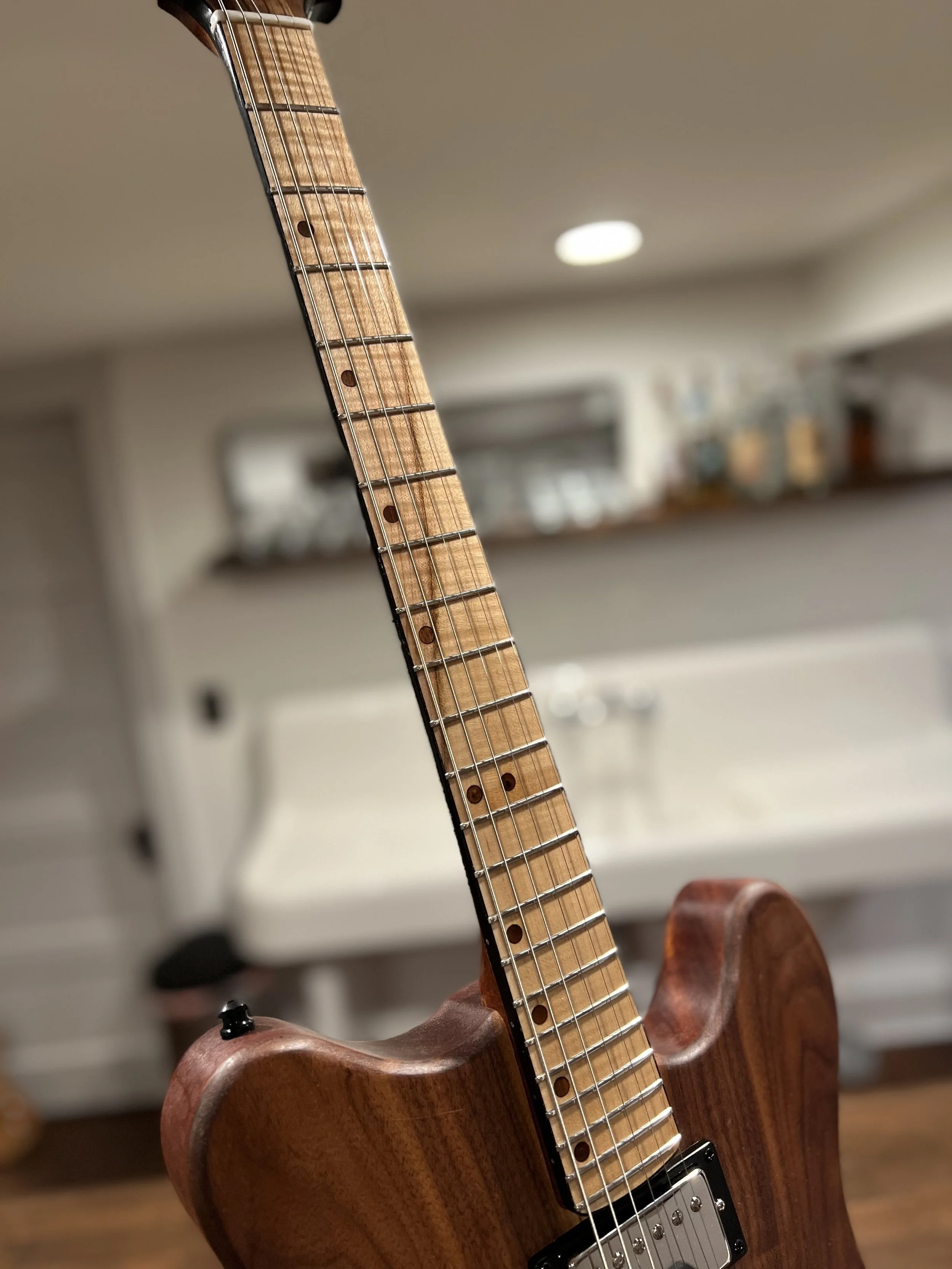
This MachMachines fretboard shows the standard locations for fret markers. As you can see, there are two dots demarcating the 12th fret.
What is intonation, and how is it different from tuning?
The simplest way to describe guitar intonation is that all of the potential notes on an instrument are set at the right frequency so they sound correct relative to the open string. This is related to, but different from, tuning a guitar, which is about making sure that an open string is playing the right note. In other words, you tune a string, but you intonate an instrument.
A guitar can sound in tune when all the open strings are set to the standard E A D G B E tuning, but sound out of tune when chords are played up and down the fretboard. This is a sign of an intonation problem rather than a tuning problem.
A slight aside for the piano players out there (like my wife and co-founder): Unlike guitars and other fretted instruments, piano maintenance doesn’t really distinguish between tuning and intonation. The reason is that each piano note has its own string or set of strings, so tuning each of a piano’s 88 keys takes care of instrument intonation simultaneously. In contrast, a guitar has only 6 strings but 19-24 frets. Let’s say you have 22 frets, and therefore 23 notes to a string including the open note. That means 138 notes to get right, only 6 of which can be individually tuned.
What does this have to do with the 12th fret?
For reasons that music physicists could explain in detail and with scientific accuracy, fretted instruments cannot be precisely in-tune at every note in every key. Instead, frets are spaced as a compromise that gets close enough for the human ear, and intonation focuses on getting the octaves precise. In a guitar, the octave above an open string happens at - you guessed it! - the 12th fret.
A properly intonated guitar has an exact octave between an open string and the same string pressed down at the 12th fret. Every other note is fudging it a bit, even though most listeners can’t hear it.
(Also, some of you amateur linguists may correctly point out that octave implies the number eight rather than twelve. That’s a whole other music theory rabbit hole, so we’re going to set that aside.)
What does a luthier do to set the intonation?
Setting the intonation is step #5 in a setup. The neck relief, action, and nut height are set first, as those three factors affect how much the intonation has to compensate for the bending of the string. Then, for each string:
The open string is tuned to the correct note, measured with a tuner.
The same string is fretted at the 12th fret. The tuner will then read if the octave is sharp or flat.
If it’s sharp, the string needs to be lengthened and the saddle moved back.
If it’s flat, the string needs to be shortened and the saddle moved forward.
Any saddle adjustment restarts the process until intonation is complete.
Whether and how the saddle can be adjusted varies by guitar type
Saddle adjustments are relatively simple on most electric guitars, because most of them have independent saddle adjustment. On most tune-o-matics or hardtail bridges, the player should be able to adjust the intonation relatively easily with a screwdriver.
In contrast, most acoustics have a set saddle, approximately positioned at 3 degrees to the center line, and usually made of plastic or bone. This is where solutions to intonation problems get more complex.
Modern steel-string acoustics typically have a compensated saddle, which means it’s been formed or carved in a shape that gets it relatively close to proper intonation. If it’s poorly compensated, reshaping may be possible. Otherwise, a new compensated saddle - bought or made by a good luthier - can be installed.
For vintage steel-string acoustics with intonation problems, I usually recommend replacing uncompensated saddles. Like with replacing poorly compensated saddles, this is a straightforward swap.
Classical guitars and ukuleles typically have fixed and traditionally uncompensated saddles. Nylon strings are easier to press down, which means players themselves have more flexibility to adjust pitch while playing. While those saddles could be compensated to allow for more precise intonation, the tradition in these instruments is to accept less precision in the instrument and demand more precision from the player.
If a well-compensated saddle is still not solving an acoustic intonation problem, it is also possible to widen the saddle slot, put in a thicker saddle, and adjust the compensation at each string. A thicker saddle means more room to adjust the length of the string where it breaks over the saddle. This is invasive so it’s not usually the first suggestion.
What if the problem isn’t the saddle?
There are severe cases where the factory or maker put the bridge in the wrong place - usually too far forward. If that happens, there are two solutions - one big and one even bigger:
Big job: If it’s an acoustic with enough room on the bridge, the existing saddle slot can be filled and a new one routed. However, keep in mind that the slot fill isn’t always a perfect match. That’s worth considering with a vintage instrument.
Bigger job: Move the bridge and touch up or refinish the top.
Regardless of severity, intonation issues are usually solvable. If you’re having a problem, you can check out our repair prices and schedule some time to come by the shop at www.machmachinesmusic.com/repairs.
Author: David Showalter, MachMachines Co-founder & Head of Instruments