
How low can my action go?
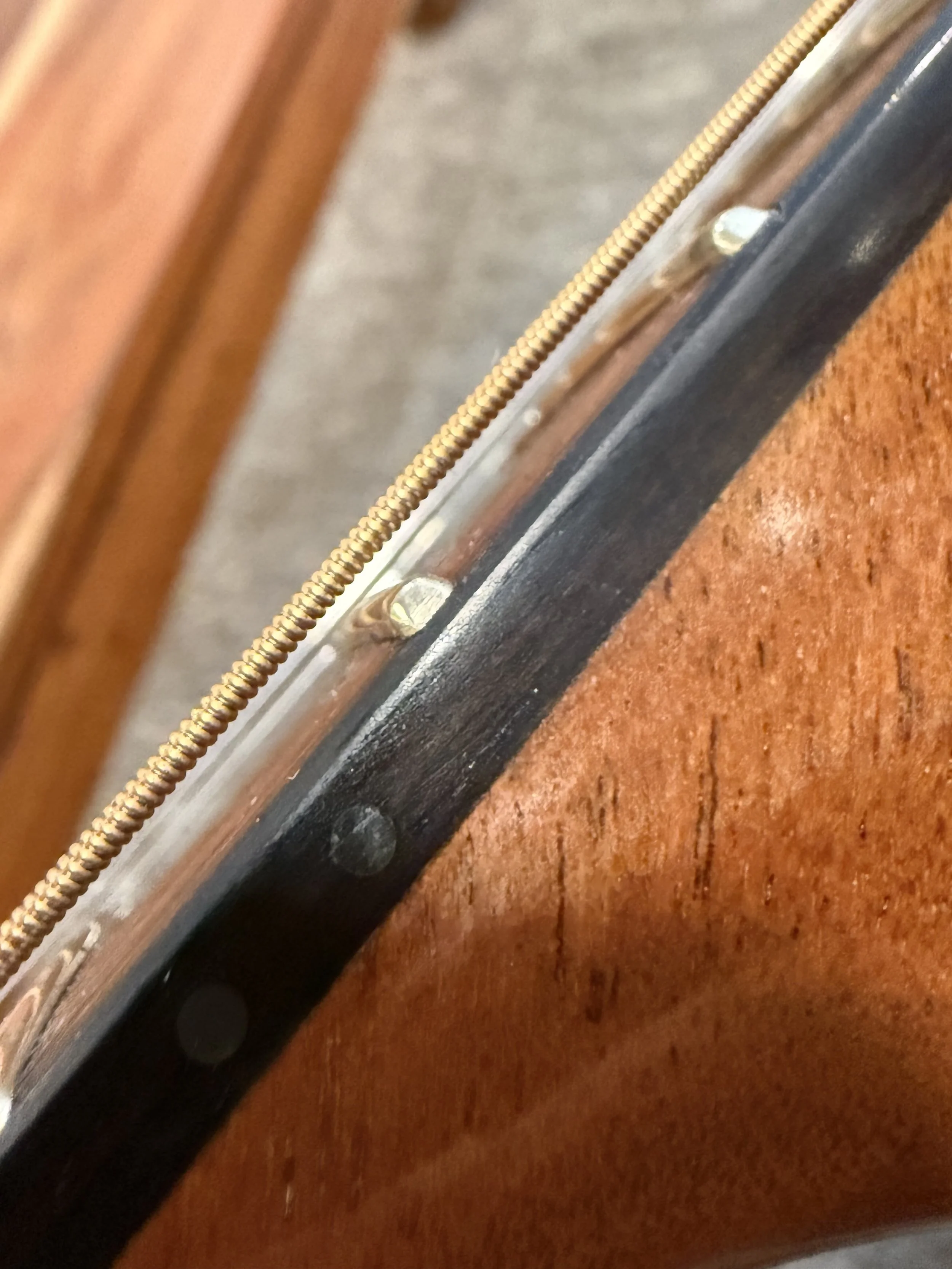
Action is measured by the distance between the top of the 12th fret and the bottom of the string.
Few things affect a player’s satisfaction with their instrument like where the action is set. Action is the distance between the top of the fret and the bottom of the string. Because necks have relief, or a slight bow, where the action is measured also matters. It is always properly measured at the 12th fret.
Between guitar teachers and the internet, a lot of players are led to believe that action is a binary choice.
There tend to be two schools of thought:
High action is best: Teachers and professionals recommend starting out and staying with higher action because it builds finger and hand strength.
Low action is best: 1980s shredders (think Eddie Van Halen) popularized super-fast finger-tapping up and down the neck, which requires less relief and lower action.
The trouble with the first camp is that if you’re just learning how to play, it will be uncomfortable and discouraging. The trouble with the second camp is that if you don’t have the technique, it’ll buzz everywhere. The trouble with both is that action is not binary at all.
Action falls along a spectrum
Action is bounded by technical upper and lower limits. Within that range, where your action should be set largely depends on who you are, how you play, and what you prefer.
On the high end, action is limited by your ability to fret the string, or press the string to the fretboard. This is ergonomic and will be different based on hand size and strength, not to mention the shape of the neck, width of the nut, etc. On the low end, there has to be enough relief in the neck and clearance over the frets for the string to vibrate freely without hitting another fret.
Truth be told, no one has ever asked me how high they can get their action. On the contrary, whether the action can get any lower is a question I get a lot. There are typically three reasons for this question:
It’s a new, lower-end guitar, and the factory has set the action high to mask poor fret and nut work, which are time-intensive to do correctly.
The neck has picked up more relief over time, usually from string tension and seasonal humidity, and it’s time for a setup so the truss rod can be adjusted.
You haven’t built or maintained the muscle strength to play as hard as you used to. Like all muscles, hands can become weaker with age or infrequent use.
You can read more about fret clearance and factory settings in the Bench Notes post on fret levels.
The action starting point varies based on instrument type
Let’s assume the frets are level and you’ve had a good setup. From there, my starting point for a standard setup depends on the instrument.
For electrics, I set the strings at 5/64th of an inch on the low E and then step down to 4/64th of an inch on the high E.
For steel-string acoustics, I start with 6/64th of an inch on the low E and step down to 5/64th of an inch on the high E.
For bass guitars, I start with 6/64th of an inch on the E and step down to 5/64th of an inch on the G.
The simplest explanation for the variance is that acoustics rely on the force of the player to affect volume, while electrics don’t require you to play harder to play louder. Bass guitars have a different scale length and neck relief, so the action setting is necessarily different.
The action ending point varies based on the individual player
I try to begin every new customer interaction - whether for repairs or new build commissions - by understanding how they play. Sometimes I’ll ask a customer to play so I can see for myself. Other times, I’ve pre-watched their band videos and have a pretty good idea. Ultimately, here are the questions I need answered and why:
Electric: What type of music are you playing?: punk, rockabilly, metal, etc. Do you dig in and play heavy or do you play light? If the former, I’ll set the action a bit higher out of the gate than my standard setup.
Acoustic: Are you a strummer or finger-style player? Finger-style players can get away with lower action; strummers need more clearance because picks create more force.
Bass: Are you plucking the strings or slappin’ & poppin’? If the latter, we need to set the action higher, because you’re slapping the strings with your thumb, hooking your fingers under the strings, and snapping the string against the frets.
But I have to reiterate that there is a lower limit to what your guitar can accommodate before the issue may be, well, you. It’s not just about how you play but how often you play and the strength of your hand and finger muscles. If you are just starting out, just picking it back up again, or experiencing muscle strain, and the action is already set as low as it can go for vibration clearance, you may need to adjust your string gauge or playing style to avoid discomfort.
If you’d like me to check out your instrument, your playing, and discuss the right action setting for you, feel free to schedule some time to stop by the shop.
Author: David Showalter, MachMachines Co-founder & Head of Instruments