
Fretboard woods: Ebony and beyond
In our first podcast episode, MachMachines player Matt Vianello talked about his strong preference for fretboards that are not made of rosewood. We want to elaborate on that discussion here; as usual, we have a lot more to say about wood.
First, a quick semantic note. The terms fingerboard and fretboard are often used interchangeably by luthiers and players, but there is a difference.
Fingerboard is the wood on a stringed instrument that is played on with a person’s fingers. This term applies to any stringed instrument whether a violin or a lute or a guitar.
Fretboard is a fingerboard that has frets. Like how all squares are rhombuses (rhombi?), but not all rhombuses are squares.
Criteria for fretboard woods
There are of course tonal differences between different types of wood. That’s why they’re called tonewoods. However, the human ear can’t really discern them when they’re used as fretboards. The most relevant factors in selecting fretboard wood have little to do with sound and everything to do with durability: is the wood hard enough and dark enough to withstand years of grubby fingers banging on it. From there, cost and abundance come into play.
Janka hardness is the scientific measurement for the relative hardness and durability of a wood species. If you want to explore that further, The Wood Database has a detailed definition and a database of more than 500 species that can be sorted by Janka hardness.
Ebony, rosewood, and maple are most common
Ebony has long been the traditional wood choice for all fingerboards, fretted or unfretted. It is extremely hard and dense. That means it can take a beating and does not take on as much moisture as other species (it won’t expand and contract as much). Ebony is also famous for being tightly-grained and darkly-colored - almost black - so it won’t discolor from the oils and dirt in human skin.
Its hardness and density also mean that ebony doesn’t need lacquer finish to be more durable or more comfortable. Most of the time, it is finished in wood oil, which can be reapplied periodically - similar to caring for a wood cutting board.
Unfortunately, ebony trees are small, slow-growing, and over-forested. As a result, most ebony species are endangered.
Rosewood is another common fretboard wood that is durable, dark-colored, and can be finished with wood oils. We heard from Matt in the podcast mentioned above that he dislikes playing rosewood fretboards. He finds it uncomfortable, which is likely due to its greater porosity. This could be solved with lacquer finish - more on lacquer-finished fretboards in the maple section below.
The bigger challenge than feel is that rosewood species are under significant conservation pressure, and Brazilian rosewood is off limits entirely.
Maple became a popular fretboard option because of Fender, which likely started using maple because it was - and remains - abundant and inexpensive. In its early days, Fender was even experimenting with slotting frets directly into maple necks without any separate fretboard at all. The ubiquity of Fenders and its ubiquitous use of maple has turned this wood into fretboard standard. However, it requires different finishing and care than ebony and rosewood.
While it is a hardwood, maple has a much lower Janka hardness. It is also obviously very light in color. As a result, it has to have a more durable finish like lacquer. This process adds time and cost, but it is still cheaper than using more exotic hardwoods, and a more durable finish can make it smooth and comfortable to play without the need to apply wood oil periodically.
However, regular play wears down the finish, so it may need to be refinished at some point. If the lacquer is too far gone, you have to do a costly refret in order to refinish.
Alternatives that are durable, dark, tightly-grained, and don’t require lacquer
Luckily, there are thousands of species of wood. MachMachines has used wenge, blackwood, marble wood, pau ferro, and even richlite - a recycled paper composite - with great results. Reclaimed woods can also be used if the wood is in good condition and the species is fit for purpose.
As often happens with trends - whether tonewoods or designer dogs - problems arise when demand for an individual species outruns the supply. It is unfortunately common for a previously-unknown wood to be discovered by the woodworking community, which leads to over-forestation, endangered status, and CITES list restrictions.
You don’t need to be an expert on any of this to buy a guitar. MachMachines can walk you though all of it when you’re ready. We only ask that you keep an open mind to the vast diversity of options so that we enjoy a sustainable supply of high quality tonewoods well into the future.
Author: David Showalter, MachMachines Co-founder & Head of Instruments
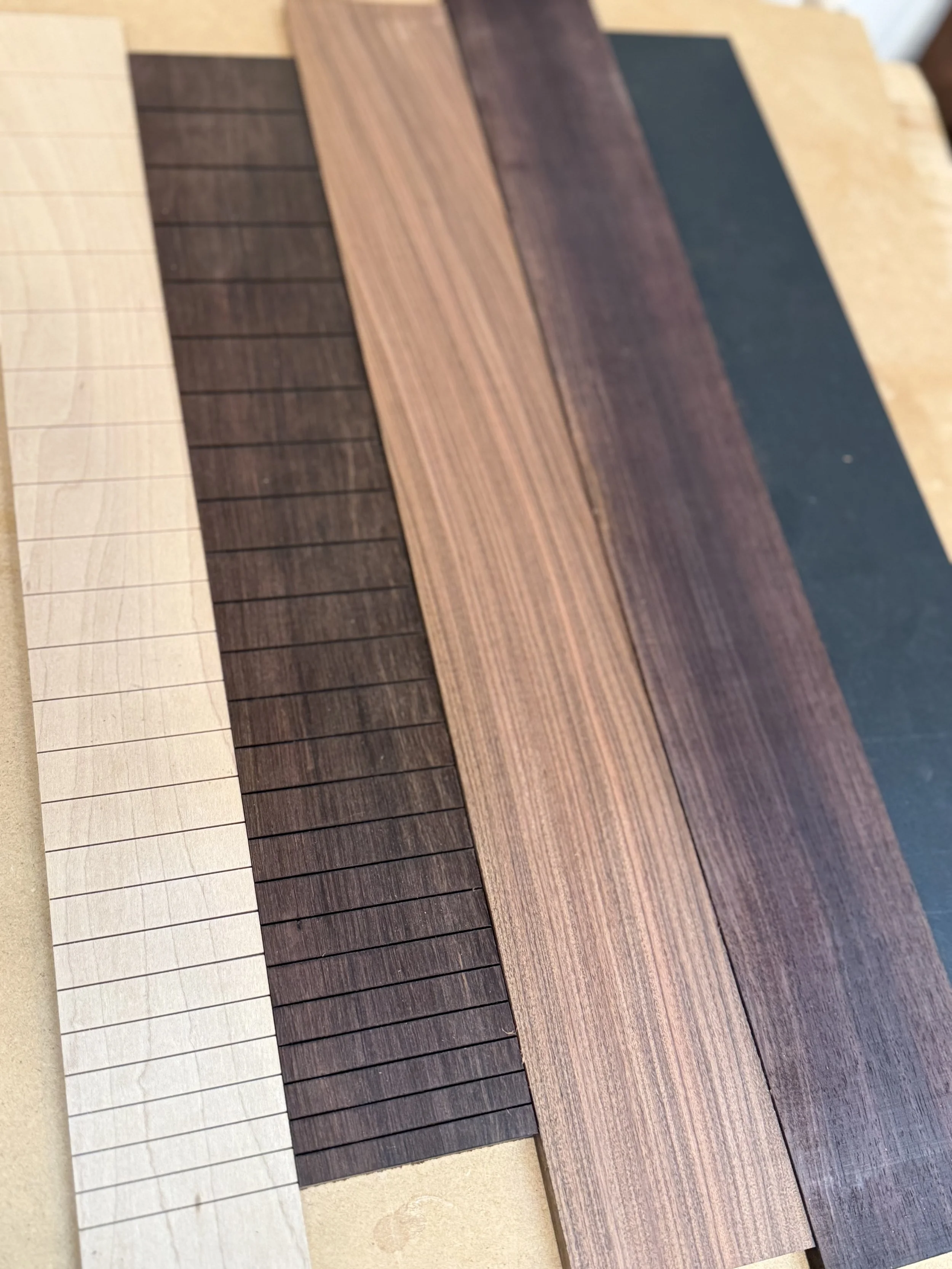
Many hardwoods have the potential to be great fretboards. These are in the MachMachines shop waiting for a neck on which to be glued.