
In our Play for Keeps podcast conversations, the topic of the guest’s starter guitar always comes up. For musicians, it’s like a first car—you’ll always love it, even if it was a junker that you totaled. We also occasionally get a question from a curious friend or fan about whether a custom instrument would be good for a beginning player. So with the holidays coming up, we wanted to provide some guidance for new players, parents, and gift givers.
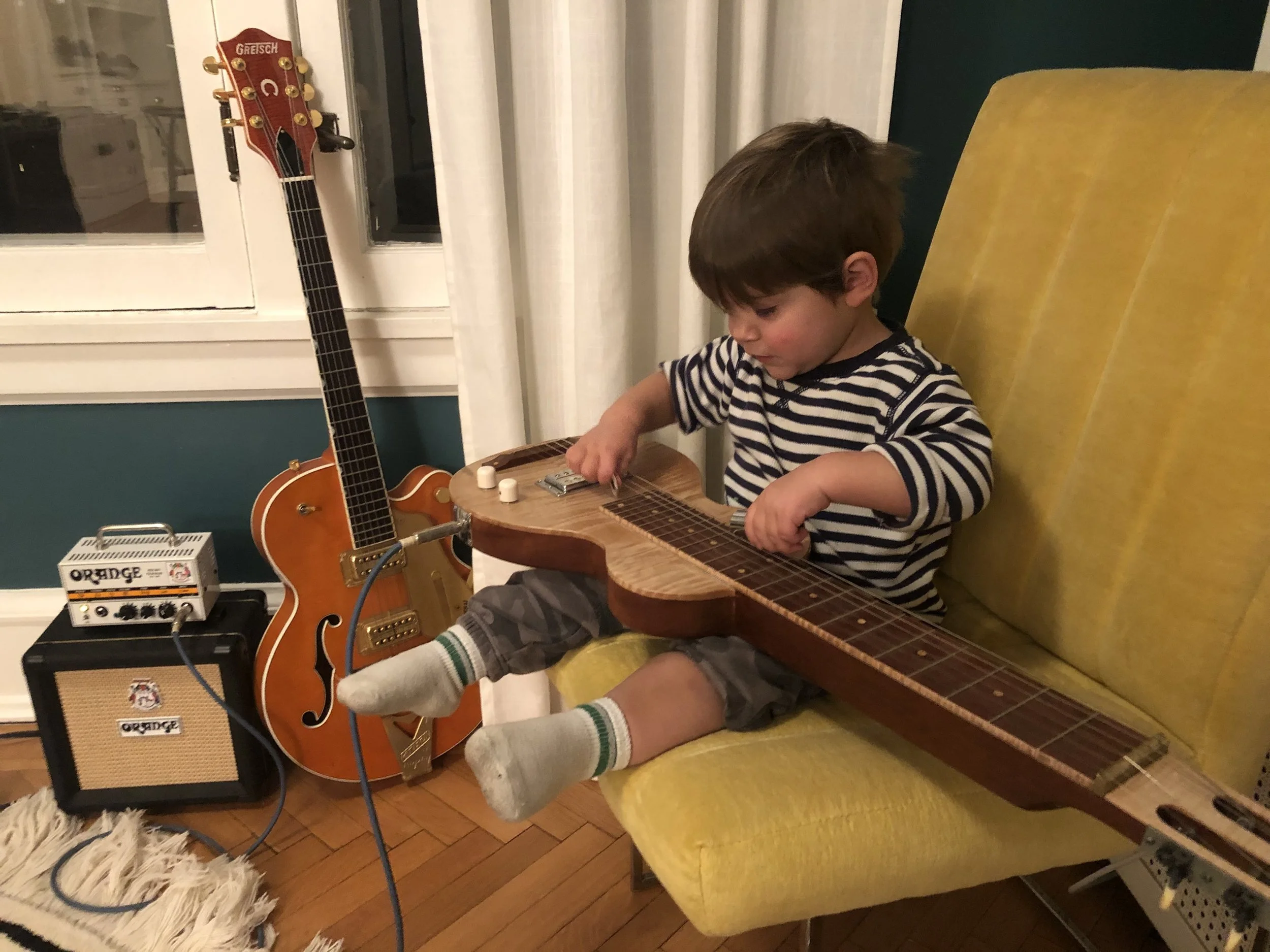
Our youngest son as a toddler playing on a lapsteel that I made
The best choice for a first instrument is unlikely to be custom
Don’t get me wrong; I will build an excellent instrument for anyone who wants one. And I have had a few ukulele commissions in particular that were intended as future gifts for young children (operative word is future). However, for the typical purchaser, this is an unusual path.
The right choice will depend on the player’s age and what kind of music they want to play. I personally would budget $300-$1,000, not including an amp, plus another $85+ for post-purchase setup.
First instruments for kids under 12
Jen and I strongly believe that all kids interested in music should start with two years of piano first. Piano lessons are unique in teaching budding musicians to read two clefs, learn melody and harmony, and manage both hands and one foot simultaneously. In music school, I found myself among many guitarists who could only read tablature. I couldn’t even tell you how many adult guitarists I’ve encountered who regret not learning piano.
But let’s say your kid doesn’t want to take my advice on starting with piano. At this age, kids will likely struggle physically with the size and weight of a guitar, even a short-scale. My parents bought me a full-size—a Martin Stinger (yes, Martin made electric guitars in the 70s and 80s!)—when I was 11, and it was unwieldy enough that I didn’t really learn to play it for another year.
Here are a few alternatives:
Rent an instrument from a local, reputable music store or music school. You’ll find out quickly if the interest is real, and the store/school will be able to size up as your kid grows.
Get a baritone ukulele. The tuning is the same as the top four strings of a guitar.
I hear good things about Loog. While I don’t have any experience with them, and they look a lot like toys to me, these might be a good starting place for younger kids.
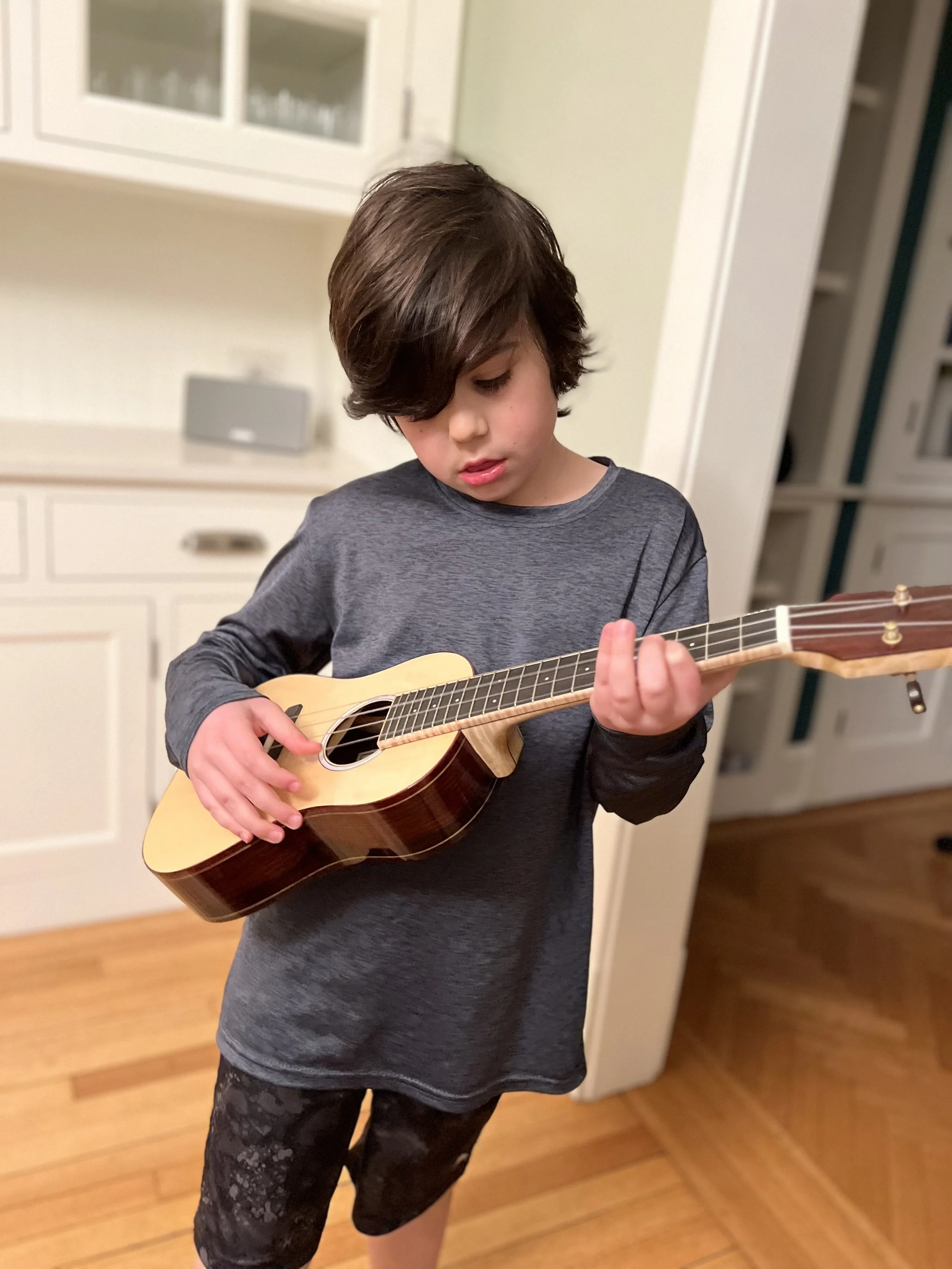
Our oldest son playing his ukulele
First instruments for adults and kids 12 and older
Once someone is physically big enough for a full-size guitar, either standard- or short-scale, it’s reasonable to purchase an instrument. This isn’t that different from buying a first car. You can choose between new or used, electric or acoustic, there are a lot of brands and models, and there are many ways to buy.
New vs. used. Either one can be fine, but it depends on where you’re buying. With used in particular, it’s easy to get a lemon if you don’t know what to look for.
Where to buy matters a lot for beginning players. There are a few options:
Independent, local music store. I highly recommend starting here, as long as it has a good reputation. These folks are invested in your community and need your support. They may have a luthier on-staff, which is important for getting an instrument that’s ready to play.
Big Box stores (in person or online). The big guys typically have it all. If buying from a brick and mortar store, they may have a guitar tech on staff, but the level of experience varies a lot. When buying online, you can expect that the instrument came straight from the factory with minimal attention given to it before being sent to you. This is a decent option for getting a new guitar from a reputable brand at a fair price.
Private sellers, Reverb, pawn shops, and antique/thrift stores. These will obviously be used-only options. No one will have checked out the quality independently. It’s a buyer-beware situation, and if you’re not an experienced guitarist yourself, you absolutely need one helping you evaluate.
What to buy. Electric vs. acoustic depends on what kind of music you want to play. Electric guitars also require an amp, so make sure you include that in your budget.
From there, I recommend going with a well-known brand. For high-end builds, I’ll always point people to an independent builder like us. However, for beginners, the choice is typically between a bargain brand of unverifiable quality and a well-known, mass-production brand. Yamaha, Fender Squier, Epiphone, and Ibanez are all examples of companies that produce good quality instruments for a beginner and are worth the extra money over a cheap guitar from an unknown brand.
If you’re buying from a physical store or private seller, play it before you buy it. Here are a few things to check:
How’s the action? Action is how high the strings sit above the frets. If you have to press hard to get a clean note, the action is probably too high. If you’re getting a lot of buzzing, the action could be too low. Action can be adjusted with a setup, but it can also point to problems with the frets or the neck. Learn more about action.
Is the neck comfortable in your hand? Hand sizes vary, and so do necks, both in width and shape. Play a few to find what feels natural.
Are the fret ends smooth or sharp? If the latter, they can cut your hands. It could be fret sprout, or it could require a refret.
Does the size and weight work for you? Try an acoustic both sitting and standing to make sure the body size suits you. Try an electric standing with a strap to check that its weight won’t wear out your shoulder.
Get a setup after you buy and before you play
Make sure your guitar is ready to play by having a qualified luthier set it up. For a used guitar, it’s like having an independent mechanic look over a car before you drive it. With new guitars, the analogy breaks down; new guitars are supposed to be set up by the factory before shipping to the store, but that corner often gets cut.
If you’re buying online, take it straight to a luthier who can, at minimum, assess it for a setup. Most brick and mortar stores that sell guitars should have a qualified person on staff that does setups. Some stores take the care to set up all the guitars on the shelf as a matter of course. However, if the store offers a setup for an additional fee when purchasing it, do it! It’s worth the extra cost.
If you’re giving a guitar as a gift, include a setup. It’s the difference between a guitar that gets played and one that stays in the closet.
If you’re in the Chicago area and just bought your next guitar—whether it’s your first or your tenth—bring it by our Oak Park shop, and I’ll make sure it’s living up to everything you hoped for when you got it. Check out pricing and make an appointment.
Author: David Showalter, MachMachines Co-founder & Head of Instruments